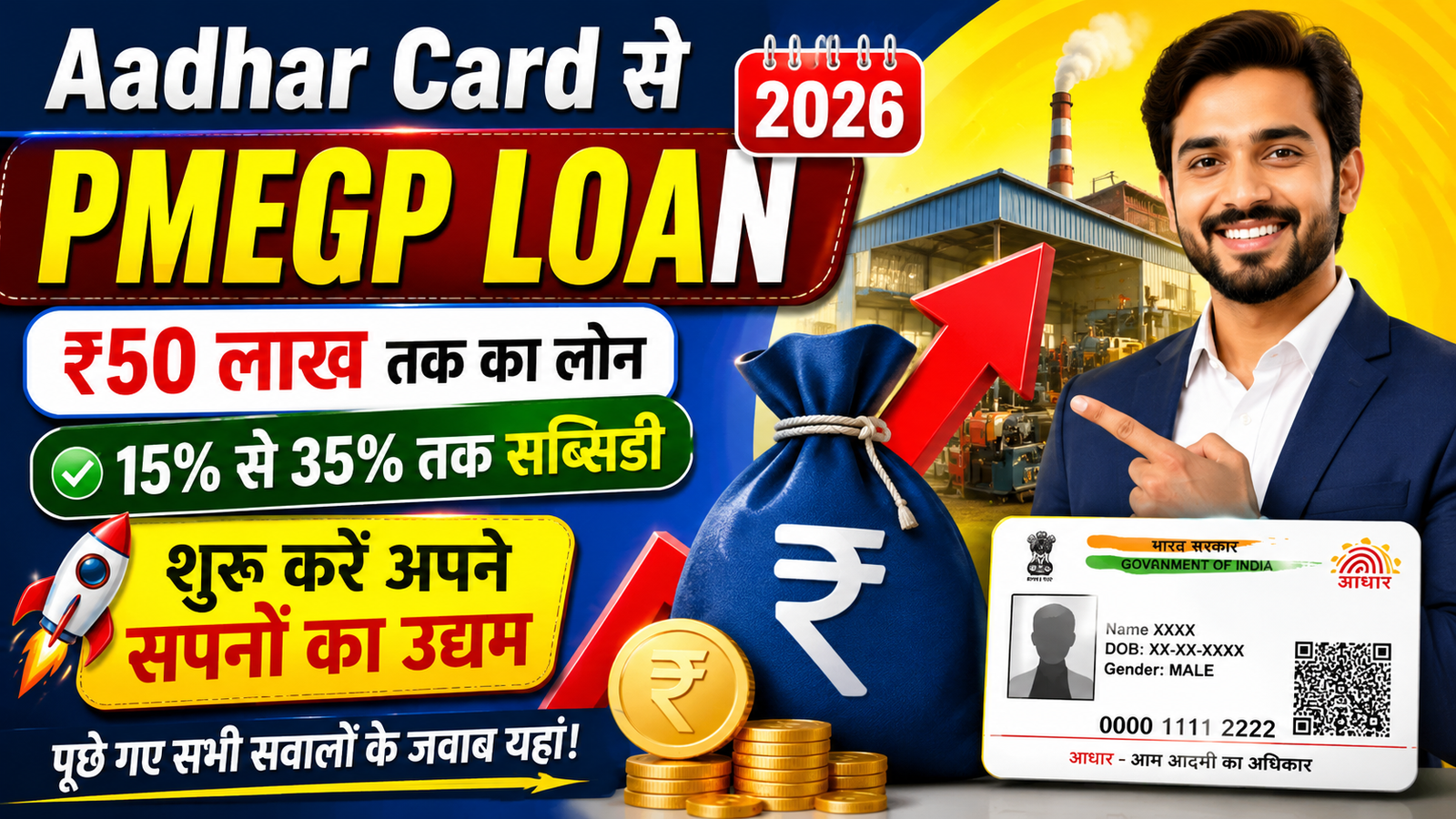
If you are planning to start your own business but are struggling because of a lack of funds, the PMEGP Loan 2026 scheme could be worth exploring.
The Prime Minister’s Employment Generation Programme (PMEGP) is a government-backed scheme designed to encourage self-employment and help eligible individuals establish new micro-enterprises.
Under this scheme, eligible applicants can receive bank finance for setting up a new business, along with a Margin Money Subsidy as per the applicable government rules.
However, there is a lot of misleading information online about PMEGP loans, especially claims that you can get a ₹50 lakh loan simply by using your Aadhaar Card.
That is not how the scheme works.
In this article, we will explain PMEGP Loan 2026, including the maximum project cost, subsidy rates, eligibility, required documents, business ideas, application process, interest, and the role of Aadhaar Card.
Also Read: How to Link Aadhaar with Your Bank Account Online (NPCI Aadhaar Seeding Guide)
What Is PMEGP Loan 2026?
PMEGP stands for Prime Minister’s Employment Generation Programme.
It is a credit-linked subsidy scheme intended to promote self-employment and encourage people to establish new micro-enterprises.
Under PMEGP, an eligible applicant can approach a bank for financial assistance to start a new business. The government provides a Margin Money Subsidy according to the applicant’s category and the location of the project.
It is important to understand that the government does not simply transfer the entire loan amount into your bank account.
The application is evaluated, the proposed business is assessed, and the bank makes the final decision regarding financing based on the applicable rules and its assessment.
How Much Loan Can You Get Under PMEGP?
PMEGP allows projects with different maximum costs depending on the type of business.
The commonly applicable limits are:
| Sector | Maximum Project Cost |
|---|---|
| Manufacturing | Up to ₹50 lakh |
| Business/Service | Up to ₹20 lakh |
However, these are maximum project cost limits, not guaranteed loan amounts.
You should not assume that every applicant will receive ₹50 lakh.
The actual financing can depend on several factors, including:
- Project cost
- Business viability
- Applicant’s contribution
- Project Report
- Documents
- Repayment capacity
- Bank’s assessment
- Applicable PMEGP guidelines
How Much Subsidy Is Available Under PMEGP?
The PMEGP subsidy depends mainly on the applicant’s category and whether the project is located in a rural or urban area.
Generally, the subsidy rates are:
| Applicant Category | Rural Area | Urban Area |
|---|---|---|
| General Category | 25% | 15% |
| Special Category | 35% | 25% |
The Special Category can include eligible applicants such as SC/ST, OBC, women, minorities, ex-servicemen and persons with disabilities, subject to the applicable scheme guidelines.
Since government schemes can be updated from time to time, applicants should check the latest official guidelines before submitting an application.
PMEGP Subsidy Example
Let’s understand the subsidy with a simple example.
Suppose your proposed business has a total project cost of ₹10 lakh, and you are eligible for a 25% subsidy.
The calculation would be:
₹10,00,000 × 25% = ₹2,50,000
So, the applicable Margin Money Subsidy could be ₹2.50 lakh.
But there is an important point to understand.
This does not mean that ₹2.50 lakh will simply be deposited into your bank account as free cash.
The subsidy is handled and adjusted through the bank loan process according to the PMEGP rules.
Therefore, PMEGP should not be understood as a scheme that provides free money.
Who Is Eligible for PMEGP Loan?
Eligibility is determined according to the current PMEGP guidelines. In general, applicants should meet the applicable conditions, such as:
- The applicant should generally be at least 18 years old.
- The scheme is primarily intended for establishing a new micro-enterprise.
- Certain educational qualifications may be required for specific project sizes.
- The applicant must satisfy the applicable beneficiary and family eligibility conditions.
- Previous benefits received under certain government subsidy schemes may affect eligibility.
- The proposed business must be economically viable.
- The applicant must fulfil other conditions prescribed under the PMEGP guidelines.
Most importantly, having an Aadhaar Card does not automatically make you eligible for a PMEGP loan.
Can You Get PMEGP Loan With Only an Aadhaar Card?
No.
This is one of the biggest misconceptions about PMEGP.
An Aadhaar Card can be used as an important identity and KYC document, but Aadhaar alone is not enough to get a PMEGP loan.
Depending on your application, you may also need a Project Report, PAN Card, bank details, business information, category certificates and other documents.
The bank will assess your proposal before deciding whether the loan can be sanctioned.
So, be careful if someone claims:
“Just give me your Aadhaar Card and you will definitely get a ₹50 lakh PMEGP loan.”
Such a claim can be misleading.
Documents Required for PMEGP Loan
The documents required can vary depending on the applicant, project and bank.
However, applicants may generally need:
- Aadhaar Card
- PAN Card
- Passport-size Photograph
- Bank Account Details
- Address or Residence Proof
- Educational Qualification Certificate, where applicable
- Caste Certificate, if applicable
- Special Category Certificate, if applicable
- Business Project Report
- Machinery and Equipment Cost Details
- Other documents requested by the bank or implementing agency
It is always better to confirm the exact document requirements before submitting your application.
Why Is a Project Report Important for PMEGP?
A Project Report is one of the most important parts of a PMEGP application.
It helps the bank understand how you plan to operate the business and whether the proposed project appears financially viable.
A good Project Report may include details such as:
- Type of business
- Total project cost
- Machinery and equipment expenses
- Raw material requirements
- Number of employees
- Expected production
- Estimated sales
- Expected profit
- Working capital requirements
- Amount of bank finance required
A realistic Project Report can make it easier for the bank to understand your business proposal.
Avoid using unrealistic sales or profit figures simply to make the project look attractive.
Which Businesses Can Be Started Under PMEGP?
PMEGP supports various eligible manufacturing and service-based micro-enterprises, subject to the latest scheme guidelines.
Some examples include:
- Food Processing Units
- Garment and Clothing Businesses
- Furniture Manufacturing
- Repair and Service Centres
- Computer and IT-related Services
- Small Manufacturing Units
- Rural-based Self-Employment Activities
- Other eligible micro-enterprises
However, not every business activity is automatically covered.
Before applying, check whether your proposed business appears in the currently permitted activities and whether it falls under any excluded category.
How to Apply for PMEGP Loan 2026?
The PMEGP application process can generally be understood through the following steps.
Step 1: Choose Your Business
First, decide what business you want to start and estimate its total project cost.
Step 2: Prepare a Project Report
Prepare a detailed Project Report covering your business plan, expenses, machinery, expected revenue, employment and other important details.
Step 3: Submit the Online Application
Apply through the official PMEGP online application portal.
Step 4: Upload Your Documents
Submit the required documents along with the application.
Step 5: Application Verification
Your application may be reviewed by the concerned implementing agency according to the applicable process.
Step 6: Application May Be Forwarded to a Bank
After the required evaluation, the application can be forwarded to a bank for further processing.
Step 7: Bank Assessment
The bank evaluates your project, documents, financial requirements, repayment capacity and other applicable conditions.
Step 8: Loan Sanction and Further Formalities
If the bank approves the proposal, the remaining loan and scheme-related formalities are completed according to the applicable PMEGP guidelines.
In some cases, Entrepreneurship Development Programme (EDP) Training may also be required.
Does PMEGP Loan Have Interest?
Yes.
PMEGP is a bank-linked loan scheme, so interest is applicable to the loan.
There is not necessarily one single interest rate applicable to every PMEGP applicant. The applicable rate can depend on the concerned bank, loan structure and prevailing lending rules.
Therefore, if an agent tells you about a specific interest rate, do not assume that it is final.
It is better to confirm the applicable rate directly with the concerned bank.
Is PMEGP Loan Available Without Collateral?
Collateral or security requirements can depend on factors such as:
- Loan amount
- Project
- Bank
- Applicable credit rules
- Current banking policies
Therefore, you should not assume that every PMEGP loan will automatically be available without collateral.
Before applying, ask the concerned bank about the latest security and collateral requirements applicable to your project.
Important Things to Know About PMEGP Loan
Before applying for PMEGP, keep these points in mind:
- PMEGP is not a free-money scheme.
- It is a credit-linked subsidy scheme.
- An Aadhaar Card alone does not guarantee loan approval.
- ₹50 lakh is the maximum project cost for eligible manufacturing projects, not a guaranteed loan amount for every applicant.
- The bank assesses the project before sanctioning the loan.
- A proper Project Report is important.
- Subsidy depends on the applicant’s category and project location.
- The proposed business must satisfy the applicable eligibility conditions.
- Interest is applicable according to the bank’s terms.
- Collateral requirements can depend on the applicable rules and circumstances.
- Always check the latest official guidelines before applying.
PMEGP Loan 2026 – Important Details at a Glance
| Information | Details |
|---|---|
| Scheme Name | Prime Minister’s Employment Generation Programme |
| Short Name | PMEGP |
| Main Objective | Promote self-employment and micro-enterprises |
| Manufacturing Project Limit | Up to ₹50 lakh |
| Business/Service Project Limit | Up to ₹20 lakh |
| Subsidy | Depends on category and location |
| Application | Online PMEGP Portal |
| Loan Provider | Bank/Financial Institution |
| Project Report | Important |
| Aadhaar Card | Useful for identity/KYC |
Things to Check Before Applying for PMEGP
Before submitting your PMEGP application, make sure you have a clear understanding of your proposed business.
Check your:
- Business idea
- Total project cost
- Own contribution
- Expected revenue
- Estimated expenses
- Required machinery
- Employment potential
- Applicable subsidy category
- Business eligibility
- Bank requirements
A realistic business plan is much better than showing inflated sales or profit figures just to obtain a higher loan amount.
Also, avoid anyone who promises guaranteed PMEGP approval in exchange for money or claims that a loan can be obtained simply with an Aadhaar Card.
Also Read: PF Ka Balance Kaise Check Kare 2026: मोबाइल से घर बैठे चेक करें अपना PF Balance
Final Thoughts
The PMEGP Loan 2026 scheme can be a useful financing option for eligible individuals who want to establish a new micro-enterprise.
Depending on the type of project, eligible applicants can have a project cost of up to ₹50 lakh for manufacturing and up to ₹20 lakh for business/service activities, while the applicable Margin Money Subsidy depends on the applicant’s category and project location.
However, it is important to remember that PMEGP is not a ₹50 lakh free loan scheme based only on an Aadhaar Card.
Your application can involve document verification, Project Report assessment, business viability checks and bank approval. The final financing decision depends on the applicable scheme rules and the concerned bank’s assessment.
Before applying, always verify the latest PMEGP guidelines, eligible activities, subsidy rules and application requirements through the official sources.

Ankita Kumar, founder of sabhigyan.com, is passionate about technology, smartphones, apps, and digital tools. With 8+ years of experience in the digital and tech space, he focuses on creating easy-to-understand, practical, and helpful content that makes everyday technology simpler for readers.
Advertisements